The Big Three of Very Big Feelings

Ears flat back against the head, wide open eyes, tightly closed mouth.
This dog’s body language tells us she is worried about something.
I work with a lot of people whose dogs have Very Big Feelings (VBF) about things in their world. Those big feelings may have a genetic component (extreme fear is a trait that can be passed down in utero); could be a result of a one-time event such as a very bad experience with a human; result from lack of socialization as a puppy; or may be due to the dog’s specific traits, such as a herding dog who is predisposed to startle to changes in the environment due to selective breeding.
Those VBF could be due to one, some, all, or none of these factors. Sometimes, VBF just are. When I work with my clients we begin by covering the Big 3 of their dog’s Very Big Feelings.
1.Manage the environment to reduce your dog’s exposure to what worries him.
Managing can be as simple as covering windows with fancy opaque static clingfilm or even simply taped-up waxed paper to block your dog’s visual access to things that stress him out.
If your dog growls over high-value chew treats like rawhide or pig’s ears, don’t give them to her while we work on changing those feelings.
When on walks, avoid locations with stimuli that upset your dog, such as children zipping by on skateboards or bicycles as they go to/from school. Trash pickup routes and times of day are also good ones to avoid!
Don’t try to take your dog to the dog park thinking, “maybe this time she’ll have fun.” Dog parks are not appropriate for every dog.
Have nonperishable treats stashed where you regularly sit or work, so you can distract your dog in the moment when, for instance, a delivery truck pulls up.
2. Understand that your dog isn’t doing any of this to give you a hard time. He’s having a hard time.
As I mentioned above, a dog’s fears can arise from many sources and be expressed in many ways. You didn’t cause your dog’s fears by “babying” him, letting him sleep on your bed or eat before you, or other reasons you may have heard. Fears are out of your dog’s control. The good news is that their fearful reactions can likely be reduced or possibly eliminated with the help of a rewards-based trainer who specializes in VBF.
It is ideal to start working with such a trainer as soon as you see fear-based behaviors such as hiding or aggression. The more “practice” your dog has at engaging in fearful reactions such as running away, hiding, barking, lunging, snapping, or even biting, the more those behaviors are “working” for him and the longer they might take to undo.
3. Work with a rewards-based trainer with expertise in Very Big Feelings.
Can any trainer help? Likely not.
Many excellent trainers are experts in teaching skills such as sit, stay, go to your bed, loose leash walking, coming when called, and so on. All great things for a dog to know!
Behavior scientists call this type of training operant conditioning because your dog is operating on the environment (i.e. doing something) that produces a consequence that is very rewarding for her (i.e. getting a treat when she sits).
However, not all trainers have expertise in modifying Very Big Feelings.
Recently I had a consultation with a client whose rescue dog has VBF about people in the house. At the end of our session the client commented that I was extremely generous with tossing very special treats to their dog, who was still wary of me but had warmed up a wee bit during our session. (In fact, he quickly learned that barking at me resulted in a meatball, which possibly increased his barking, but was a behavior that would shake out over time with training.)
What I was doing in that moment was pairing the appearance of something the dog found upsetting (me), with an incredibly generous flow of The Best Treats Ever. I’m talking a nearly-constant stream of meatballs, cheese, and chicken.
This is the foundation of “classical conditioning,” the pairing of a stimulus with something the dog finds inherently rewarding to create a pattern that X is reliably followed by Y. Dogs easily notice these patterns to help them navigate their world — it can be as simple as your dog getting excited when you pick up a leash, as the leash reliably predicts a fun walk.
In the case where I was tossing food rewards, I was engaging in classical counter-conditioning, as we worked to undo a negative or fearful reaction of the dog to a normal stimulus (me, a new person) by providing an incredibly generous flow of The Best Treats Ever. This training has many layers of finessing to achieve optimal results, including distance to the dog, how long I was in the environment, and more.
This type of training is not for amateurs, so I recommend asking a trainer questions before you begin working together, including “Where did you study dog training?”
More about credentials to look for and questions to ask here.
A credentialed, rewards-based trainer will also coach you on understanding your own dog’s particular body language. Context is everything … a dog who is licking her lips may be showing concern about something coming her way, or may be anticipating a treat. What else is going on in the environment? The website I Speak Dog breaks down body language very well.
So when thinking about how to help your dog’s VBF, start with these 3 tips and, as always, reach out if you have questions!
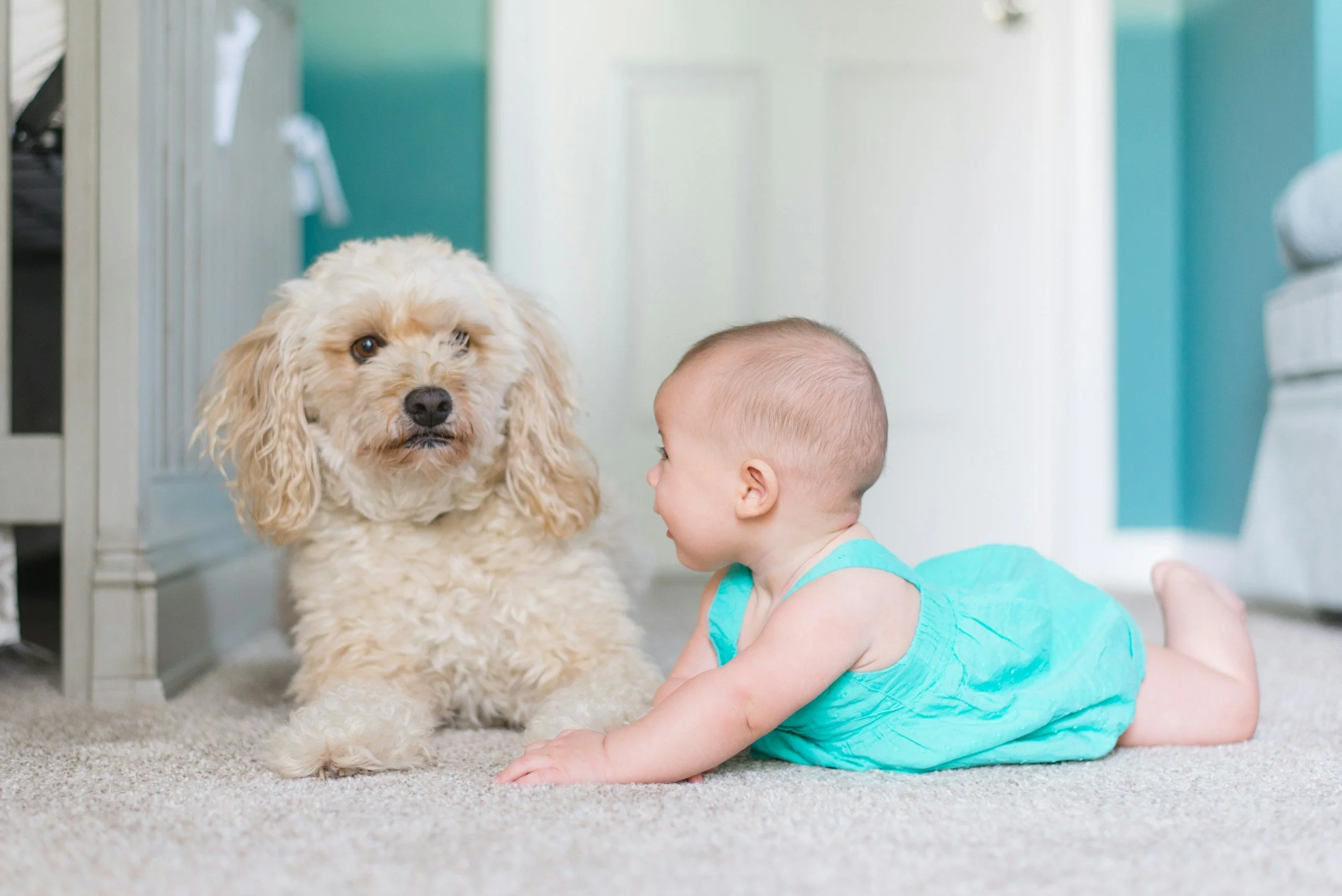
Note that this worried dog isn’t moving away from the approaching baby.
It’s a myth that a worried or frightened dog will always move away. They’re just as likely to stay put and use their communication tools — stares, growls, snaps, and bites — to make the baby (who understands none of these) move away.