Our spring manners refresher
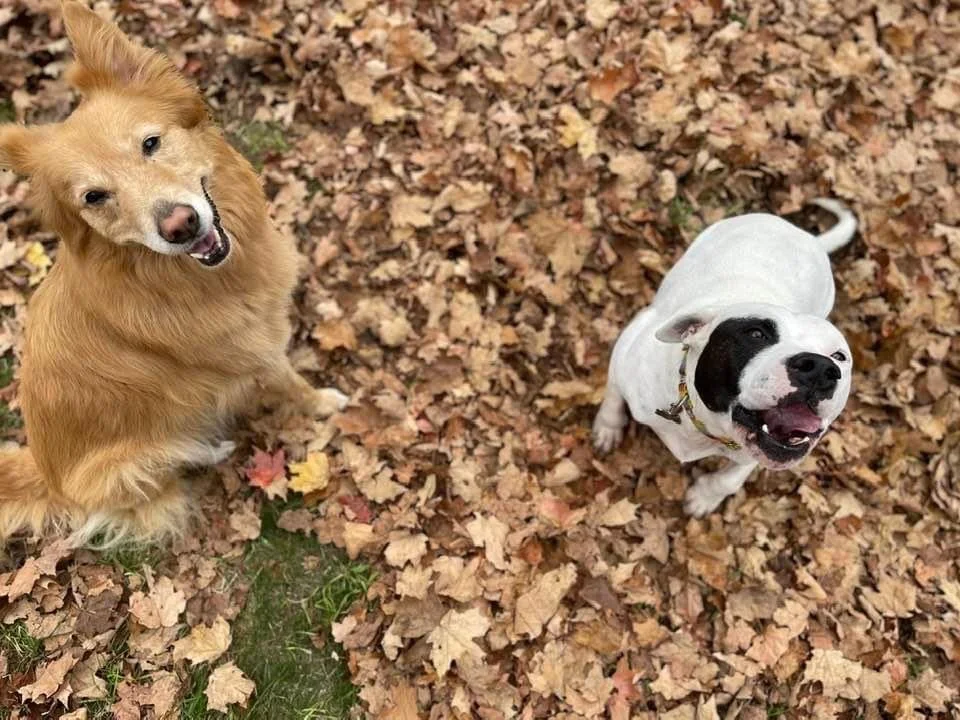
Our own dogs are not immune to needing a springtime manners refresher
Daisy, 12 (left) and Petey, 9, have some rusty behaviors as we once again venture deep into our woods
My husband and I are absolutely thrilled that spring has arrived in our little corner of Southeastern Vermont. We’re watching the snow recede from the yard, checking for buds on our peach tree, packing away the snowblower and bird feeders, and starting herb seeds for our garden.
Dog trainers work with their own dogs, too
We’re also once again going for long walks with our dogs in the state forest directly behind our house. These have been on hold pretty much since January, because the snow has been so deep that while we could navigate it on snowshoes, the dogs couldn’t get anywhere.
For the past week or so we’ve been hitting the trails and quickly realized that the dogs have spring fever, and some of their manners need a serious refresher.
How dogs learn and why they “forget”
Dogs learn new behaviors the same way we learn an instrument: Lots of coaching and practicing of easy iterations of a behavior (such as ignoring food on the floor) and progressing to challenging versions of the behavior (ignoring the porcupine sitting on a log in the woods).

I learned ukulele well into adulthood and know about 5 - 6 chords.
I know the only way to keep skills up is to practice regularly. Picking it up several times a week and strumming a few chords supports muscle memory.
If I let it go for a few months, it takes me quite a while to remember where my fingers go, and how to strum.
Manners may be rusty yet temptations abound
Nowadays the woodland creatures are on the move: deer, turkeys, bears, raccoon, possums, foxes, chipmunks, and porcupines. All of that means there there are a ton of critter droppings in the woods, and our Petey is eager to sniff and eat them all. We noticed that his “leave it” is an absolutely ignored verbal cue. (Petey does wear a muzzle to prevent him from eating too much of these “delicacies.”)
We also noticed neither dog responded well to our recall word, “Scooby Doo!”
We sometimes take Petey out for a leashed walk down our dirt road, where he also is eager to sample the delights of the woodland critters and his “leave it” cue goes in one ear and out the other. Interestingly, our vet asked at a recent check-up if we felt he had been losing his hearing. With him, it’s hard to tell, as he is so tuned in to food, delicious non-food, and chasing critters, but it’s something we’re watching for.
Develop your training plan and your management plan
Our training plan includes:
Identifying the essential behaviors we want to brush up: Leave It (shorthand for “Stop what you’re doing and come back to me”); hand touches (a well-learned behavior that brings the dogs back to us); recall, and “Yes!” which we say when the dogs glance even vaguely in our direction in the woods, and usually results in them coming to us for a snack
Remembering to bring our dogs’ favorite super-duper treats, always, on all walks, both leashed and unleashed
Research shows dogs are more motivated to work for their preferred food rewards
Randomizing rewards and having the occasional “jackpot”
Practicing these behaviors in a no-distraction environment (in the house), then in the yard, then with increasing distraction and distance from us
For instance, we practice recall in the woods when the dogs are only 5’ - 10’ away and slowly increase the distance
Integrating these behaviors into everyday life: asking for a hand touch before putting on a harness or giving a food toy; randomly rewarding attention with a Yes and a treat
Start practicing the manners after they’ve first explored a bit and done their business, but before they’re engaged in something enthralling
For Petey, this means asking for a Leave It just as he starts sniffing the ground, well before he’s trying to snarf up a dropping
We’re adding hand gestures to Petey’s behaviors (a thumbs-up for “Yes!”, a double-arm-swing like the airport marshal pictured, and extending our hand (which we never stopped doing) for touch
Because we never stopped extending our hand when asking for a “touch,” both dogs respond to it without the verbal cue (if they’re looking in our direction)
And we rely heavily on management:
Avoid temptations to begin with
We try to scan ahead for nasty delicious woods snacks and maneuver Petey elsewhere before he sees it
We avoid locations where we know the dogs will be tempted to search for critters (we call these areas Porcupine Alley and Chipmunk Hill)
On a leashed road walk we maneuver Petey to the other side of the road from, say, recent roadkill well before we reach it and do lots of repetitions of hand touches to divert his attention
Petey stays on leash in the woods just in case he really is losing his hearing and doesn’t hear the Scooby-Doo

our hand gesture for Scooby-Doo somewhat resembles the gestures of an airport marshal, waving Petey and Daisy toward us with lots of enthusiasm
So think about what you need your dog to do
Prioritize the behaviors most important to you so you’re not tackling several at once. For instance, our dog Daisy looks at us (checks in) frequently and doesn’t eat woodland droppings so we’re not bothering tuning up a Leave It for her. Another dog may need more practice simply to look around for his people outside. Pick a few behaviors, break out your training plans and special treats, and get started!
And, as always, reach out if you need help — I’m offering a 4-session Springtime Manners Refresher training program right now! Find out more at the link below.