Socializing your new adult dog
Have you adopted or rehomed an adult dog? Good for you!
Discover how to keep them feeling safe as they settle into their new Life.
Veterinary behaviorists and researchers agree that the priority when you bring home a puppy is teaching them that the world is safe. But what if you’ve adopted an adult dog who is shy and skittish – or defensive and fearful – around people?
It’s normal for animals to be fearful — in fact, it’s a survival skill
Most dogs who are shy or fearful around new people are that way they are through errors of omission rather than commission. Something in their genes or background makes them default to a fear response.
Fearfulness is a genetic setting in animals that has been shaped over eons. Erring on the side of avoiding new things served the ancestors of dogs very well.
Humans can address fear in dogs in two ways: genetics (i.e. not breeding dogs who are fearful) and environment (padding them with many positive, safe experiences from an early age). If we don't attend to genetics and environment, default fearfulness emerges, which is why shyness and fear-aggression is so prevalent.
Play it safe while you gather information about your new dog
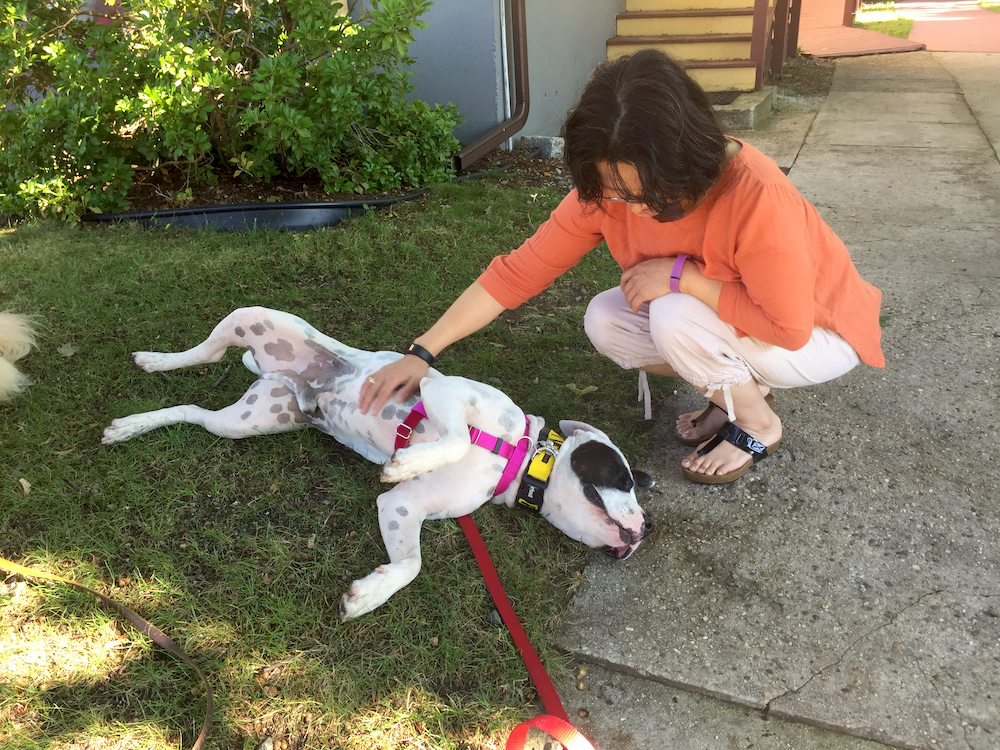
When we brought home our dog Petey he was 2 years old and hadn’t met too many people in his life as he’d mostly lived in rescues.
On neighborhood walks we let him call the shots as to whether he wanted to approach and be pet by people. I think he is enjoying himself, don’t you?
When you bring a new dog home, don’t take it for granted that he will be friendly to all people, even if he took to you on your first meeting or the foster says “she loves everyone.” Love, as Mariah Carey reminds us, takes time.
Socialization is specific: Dogs who are comfortable around adults are not necessarily well-socialized to children, and dogs who like women won’t necessarily like men. So gather intel while playing it safe around new people.
#1 rule for playing it safe: Give your dog distance
Nobody should reach for or touch your dog if your dog hasn’t moseyed up to them first. This moseying up is called “pro-social” behavior, and is in contrast to anti-social behavior (frank fight or flight) and the less obvious “asocial” behavior, which is a dog simply standing still. Still waters can run deep, so be cautious.
If your new dog is pro-social to all groups, first celebrate – this is unusual and wonderful – and, second, think of maintenance. Get him out regularly, and avoid bad experiences. Some dogs do “de-socialize” if they are allowed to get rusty. One really bad experience – such as a self-proclaimed dog expert forcing his attention on your dog – can create a lifelong fear in an instant.
Dogs have the right to say “No thanks”
Some dogs are “asocial” — no frank fight or flight, just no interest in people — until the people get too close.
If anyone reaches for or tries to call or lure over your asocial dog, slow them down. I coach clients to say something like “I appreciate you want to say hi! Fluffy is frightened of new people and you can help her by ignoring her right now. Want to toss her some treats?” Having them gently toss treats away from and behind your dog (creating more distance) can be an interaction that satisfies both your friend and your dog.
The worst case scenario will be if your uncomfortable dog feels the need to aggress with snarls, barks, lunges, or even bites, which will indeed work like a charm to back the person off. And now he’s learned that offense is a great defense.
If your dog wants contact, he’ll approach. All dogs have the right to say “no” and we want them doing this without their teeth. Empower him to have the choice.
Confidence building activities
The best one is reward-based training. Even if he’s a model dog and doesn’t need training, make manners part of your daily routine with, for instance, hand-touches or sits before opening the door for him. Enroll in a rewards-based class, work with a private trainer, or take a tricks class (there are fun ones online, many free).
Remember to play! If he doesn’t seem to be much of a fetcher or tugger on the face of it, don’t give up. Persevere at trying to engage him.
Work-to-eat toys and enrichment activities are excellent for behavioral wellness. There are a huge variety of food toys that can accommodate part or all of his daily meal ration. One of Petey’s favorites is hunting for his kibble in the backyard, even in the snow.
Dogs have a common ancestor with wolves, who are consummate problem-solving predators, and free food in a bowl doesn’t do your dog’s inherent drives any favors.
The prognosis
With good management, which means protecting them from pushy people, shy dogs tend to continue making gradual improvements over the course of their lives. But if he starts off barking, lunging or biting, don’t despair. You need professional help, so engage a credentialed trainer who specializes in dogs with fearful and aggressive behaviors.